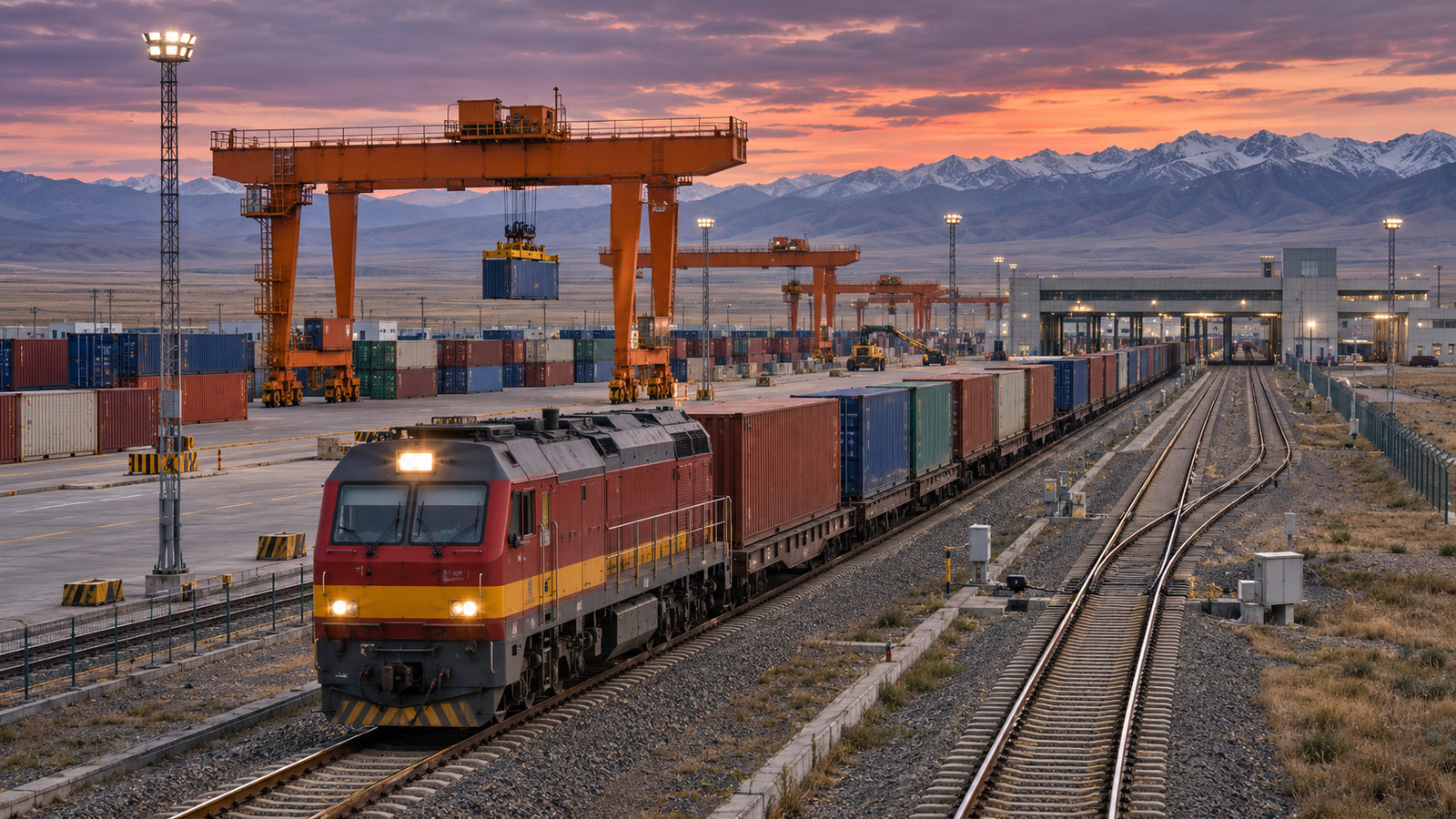
According to railway authorities and media reports, traffic of China-Europe (Central Asia) freight trains through the Khorgos railway port has maintained steady growth. According to railway sources, traffic through this single port alone surpassed 8,000 trains as of November 3, while local media reported that as of November 4, the port exceeded 8,000 trains, with cargo throughput surpassing 13.8 million tons. Serving as an important railway node between China and Kazakhstan, Khorgos continues to streamline customs operations and enhance cross-border transport efficiency.
What are the specific figures for the single port of Khorgos compared with the dual-port totals?
According to railway sources, on November 3 at 17:00, a freight train loaded with machinery, auto parts, and electronic products departed from Khorgos for Lodz, Poland, bringing the single port's total to over 8,000 trains as of that day. Local media (Aksu News Network via Xinjiang Daily) reported the milestone as of November 4, noting that train numbers had exceeded 8,000 and cargo volume had topped 13.8 million tons. In terms of dual-port data, the two railway ports of Alashankou and Khorgos have collectively handled 15,775 China-Europe (Central Asia) freight trains and 32.074 million tons of cargo this year.
What efficiency improvements have been made in cross-border transshipment and customs operations?
The Khorgos railway port is situated only 13.2 km away from Kazakhstan's Altynkol railway port. Because track gauges differ between China and Kazakhstan, cross-border cargo must be transshipped at the freight yard. Li Wenbin, deputy director of the safety production command center at Khorgos Station under China Railway Urumqi Group, explained that the implementation of paperless data pre-clearance allows customs procedures to be completed ahead of train arrival, enabling departure in as little as 30 minutes. Dwell time for import goods has been reduced from 2–3 days to under 16 hours, while local export processing time has decreased from 6 hours to 1 hour. The daily average number of trains handled has risen from 2–3 in earlier years to 27 at present. Jiang Pengfei, deputy director of the freight workshop at Khorgos Station, noted that containers arriving from Kazakhstan are lifted and loaded onto domestic trains without delay.
What is the network reach of the freight routes and what types of cargo are transported?
To date, 91 train routes operate through the Khorgos railway port, connecting to 18 foreign countries and 46 cities and regions, transporting more than 200 categories of cargo. Regarding cargo structure, inbound freight mainly consists of raw materials such as wheat flour, barley flour, and mineral ores. Outbound westbound trains carry items such as new energy vehicles, auto components, mechanical equipment, and electronic products.
Frequently Asked Questions
What are the reported dates for Khorgos reaching the 8,000-train milestone?
Railway sources reported that the milestone was reached as of November 3 with a train departing for Lodz; local Xinjiang media reported the figure as of November 4.
How do the figures of 8,000 trains and 15,775 trains differ?
The figure of 8,000 trains (exceeding 13.8 million tons of cargo) applies solely to the single railway port of Khorgos. The figure of 15,775 trains (32.074 million tons of cargo) is the combined total for both Alashankou and Khorgos ports.
Rules related to this news
- China Kazakhstan rail freight volume 2025In 2025 China–Kazakhstan rail freight was 35.6 million t (+11%); road freight about 8 million t (+40%); about 85% of C…Text and legal basis →
- 外国人能否成为边境类经济特区(与欧亚经济联盟关境重合)的参与者No.Text and legal basis →
- “霍尔果斯—东大门”经济特区的位置、面积与定位The regulation on the Khorgos – Eastern Gate SEZ was approved by Government Decree No.Text and legal basis →
Why is cargo transshipment necessary at the border?
Khorgos is 13.2 km from Kazakhstan's Altynkol railway port. Because the track gauges differ, cross-border cargo must be transshipped at Khorgos.
What are the primary import and export goods handled at the port?
Imports consist largely of wheat flour, barley flour, and ores; exports can include new energy vehicles, automotive parts, machinery, and electronics.
What does this news mean for Chinese enterprises?
Surpassing 8,000 trains at the single port of Khorgos and achieving shorter dwell and transshipment times demonstrate the high operational capacity of the cross-border transit corridor via Kazakhstan. For Chinese manufacturers supplying Central Asian and European markets, expedited border handling provides dependable transport for new energy vehicles, machinery, and electronics. For enterprises importing agricultural commodities and mineral resources from Kazakhstan, faster turnaround at the border helps improve supply chain fluidity.
Further Reading
- More industry and policy updates: Kazakhstan Investment and Projects News
- Setting up a project company: Company Registration Services in Kazakhstan
Sources
- Hong Kong Commercial Daily, November 6, 2026: https://www.hkcd.com/hkcdweb/content_p/2026/11/06/content_204455.html
- Aksu News Network (Xinjiang Daily), November 4, 2026: https://www.aksxw.com/sy/rdxw/xj/202611/t20261104_37083977.html
- CCTV.com, November 4, 2026: https://tv.cctv.com/2026/11/04/VIDEZqDk05qAy59l9qQar6Tf261104.shtml
Key facts
- The single Khorgos Railway Port has handled more than 8,000 China-Europe (Central Asia) freight trains cumulatively this year, with cargo throughput exceeding 13.8 million tonnes.
- Khorgos Railway Port currently operates 91 routes, reaching 18 countries and 46 cities and regions overseas.
- Through paperless pre-processing and the “data precedes trains” approach, Khorgos Station has reduced the dwell time for imported goods to under 16 hours and on-site export handling time to 1 hour.
- Khorgos Railway Port operates an average of 27 freight trains per day.
- The Alashankou and Khorgos railway ports have handled a combined total of 15,775 China-Europe (Central Asia) freight trains and 32.074 million tonnes of cargo.
- Khorgos Railway Port imports raw materials such as wheat flour, barley flour and ores, while westbound freight trains export high-value goods including new energy vehicles, auto parts, machinery and electronic products.
FAQ
How should the timing of Khorgos Railway Port surpassing 8,000 trains be stated?
According to railway authorities, the single port surpassed 8,000 trains after the train bound for Łódź, Poland, departed at 17:00 on 3 November; local media reported that the figure had surpassed 8,000 as of 4 November.
What are the respective statistical scopes of the figures of 8,000 trains and 15,775 trains?
The figures of 8,000 trains and more than 13.8 million tonnes refer to the single Khorgos Railway Port, while 15,775 trains and 32.074 million tonnes represent the combined throughput of the Alashankou and Khorgos railway ports.
Why must cross-border cargo be transshipped at Khorgos?
Because the track gauges in China and Kazakhstan differ, cross-border cargo must be transshipped between the Khorgos and Altynkol ports, which are 13.2 kilometres apart.
What routes and principal cargoes does Khorgos Railway Port currently serve?
The port currently operates 91 routes, reaching 18 countries and 46 cities and regions overseas. Imports consist mainly of raw materials such as wheat flour, barley flour and ores, while westbound freight trains carry exports including new energy vehicles, auto parts, machinery and electronic products.
What does improved port efficiency mean for Chinese companies?
The dwell time for imported goods has been reduced to under 16 hours, and on-site export handling has been shortened to 1 hour. This facilitates export deliveries of new energy vehicles, machinery, electronic products and other goods, as well as import transshipment of raw materials such as ores, grains and edible oils.