KazMunayGas is in talks with four foreign oil companies about a new exploration consortium aimed at the deepest subsalt formations of the Precaspian Basin. Two of the four are Chinese, Sinopec and CNOOC; the other two are Shell and Chevron. The consortium has not been formed yet, and stakes, cost sharing and the choice of operator have not been disclosed.
The news comes from Kurmangazy Iskaziyev, first deputy chair of KMG's management board. On September 30 he spoke at the KIOGE-2026 plenary session in Almaty, and KMG's press release afterwards said Shell, Chevron, CNOOC and Sinopec had shown interest in the regional study of the Precaspian subsalt complex and that KMG was negotiating a consortium. He named the same four companies in an October 1 interview with S&P Global Platts in Almaty and again when speaking to the Kazakh business outlet LS on October 13.
Both interviews give the same depth range: 5.5 to 10 kilometers. According to Iskaziyev, the deepest drilling in Kazakhstan so far, including the deep sections at Tengiz and Kashagan, reaches about 5.5 kilometers. The consortium would be working in an interval the country has barely touched.
The seismic program sets the scale. KMG plans roughly 60,000 line-kilometers of regional 2D seismic across the Precaspian Basin. The company first gave that figure in April at the GECA-2026 geology forum in Astana, describing an area of about 200,000 square kilometers, and it was unchanged in the September release and in both interviews. KMG estimates the subsalt complex's potential at up to 60 billion tonnes of oil equivalent. That is the company's own geological estimate, not proven reserves, and the gap between the two is large.
On money and timing, each figure so far has a single source. Iskaziyev told LS that preliminary investment under the consortium would be about USD 500 million, with drilling capex counted separately and higher; LS reported that the consortium is expected to be set up by the end of 2026. Platts reported that the work is due to start next year, with the seismic acquisition spread over three years. The two accounts fit together, but no agreement has been signed, so they should be read as plans.
The Chinese companies are not starting from scratch. On June 24, 2025, CNOOC's wholly owned unit CNOOC Hong Kong Holding signed an exploration and production contract for the Zhylyoi subsoil area with Kazakhstan's Ministry of Energy and KMG. The block lies partly in Atyrau region and partly in the Kazakh sector of the Caspian Sea, covers about 958 square kilometers, has a nine-year first exploration stage and is split 50/50. A KMG disclosure on KASE shows that Sinopec International Energy Investment Holdings Netherlands B.V. signed a contract for the Berezovskiy area in West Kazakhstan region on October 29, 2025. KMG's September release noted that CNOOC is investing in Kazakhstan for the first time.
Rules related to this news
- China Kazakhstan joint projects numberThe two countries are implementing 260 large joint projects worth over USD 62 bn; the project pipeline holds 329 proje…Text and legal basis →
- What is the Alatau Industrial Trade and Logistics Complex SEZ in Zhambyl region?The Alatau Industrial Trade and Logistics Complex SEZ was created by Government Decree No.Text and legal basis →
The difference is scope. Each of those contracts covers a single block. The new consortium would study the basin as a whole, mapping the subsalt complex first and deciding where to drill afterwards.
KMG is open about the difficulties: high reservoir pressure, heavy hydrogen sulfide content and thick salt layers on top. According to Platts, Iskaziyev sees CNOOC's deepwater experience in Guyana as relevant to these conditions.
Why now? KMG points to natural decline at mature fields. At KIOGE the company said 12 priority fields deliver about 90% of production and that it has adopted a strategy to raise oil recovery there, while exploration is meant to rebuild the resource base over the longer term: a program of 23 projects with a geological resource base of about 4.7 billion tonnes of oil equivalent. BP is coming back too, through the Ustyurt-1/2 project according to KMG, and Platts reported that a contract for a major block could be signed before the end of the year.
What follows is our editorial reading, not a position of any party. For Chinese companies and oilfield service suppliers in Kazakhstan, regional seismic acquisition, ultra-deep drilling, sour-fluid handling and anti-corrosion materials tend to be where such projects spend money first. If the consortium takes shape, procurement and subcontracting rules will be set by the consortium and KMG; no public tenders have been announced in this area. Four things are worth watching: whether an agreement is signed, how stakes are split, who operates, and when a seismic tender is announced.
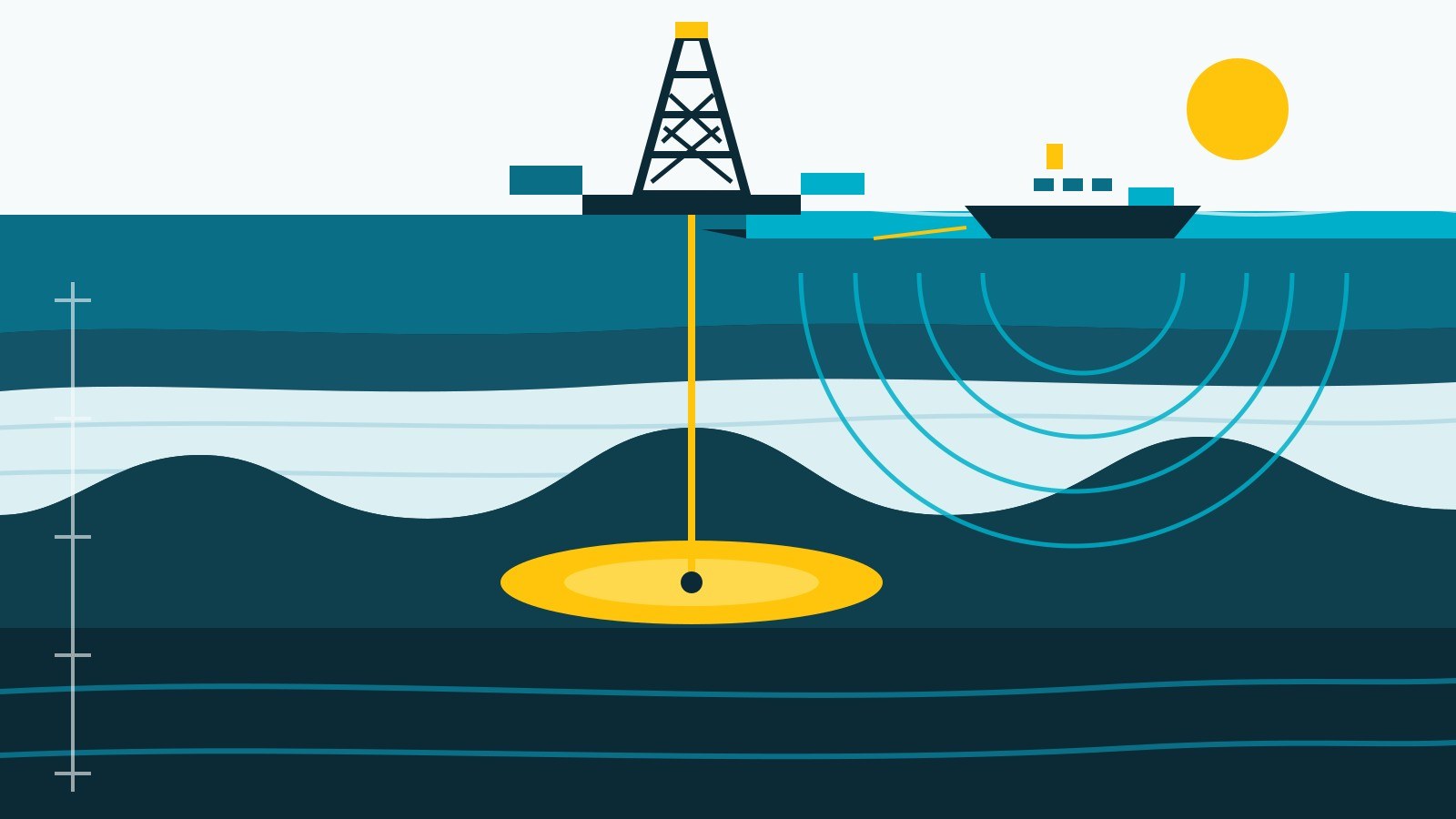
The cover image is an AI-generated illustration and does not depict the events described.
Sources:
KazMunayGas(KMG), https://www.kmg.kz/ru/press-center/press-releases/kioge-2026-kmg-uchastie-plenarka/
KazMunayGas(KMG), https://www.kmg.kz/ru/press-center/press-releases/geca-2026-iskaziev-vistupleniye/
LS, https://lsm.kz/neftyanye-giganty-ob-edinyatsya-dlya-poiska-novoj-nefti-v-kazahstane
Hellenic Shipping News / S&P Global Platts, https://www.hellenicshippingnews.com/kazmunaygas-seeks-consortium-to-develop-deep-caspian-oil-reserves/
Kursiv Media, https://kz.kursiv.media/en/2026-10-13/engk-nknk-oil-giants-could-invest-500-million-in-exploration-in-kazakhstan/
CNOOC Limited, https://www.cnoocltd.com/english/presscenter/pressreleases/2025/202506/t20250624_116335.html
KASE, https://kase.kz/en/information/news/show/1554269
Key facts
- Kazakhstan's national oil and gas company KMG is in talks with Sinopec, CNOOC, Shell, and Chevron to form an exploration consortium.
- The proposed consortium would target pre-salt formations in the Caspian Sea basin at depths of 5.5 to 10 kilometers, but it has not yet been established.
- KMG plans to conduct approximately 60,000 linear kilometers of 2D regional seismic exploration in the Caspian Sea basin.
- KMG estimates the resource potential of the pre-salt succession at up to 60 billion tonnes of oil equivalent; this figure does not represent proven reserves.
- KMG says preliminary investment within the consortium framework would be approximately USD 500 million, with drilling capital expenditure accounted for separately; this has not been corroborated by a second source or a formal agreement.
- Deep pre-salt exploration in the Caspian Sea basin is complicated by high pressures, high hydrogen sulfide content, and thick salt layers.
FAQ
Which companies are currently participating in talks to form the Kazakhstan pre-salt exploration consortium?
Kazakhstan's national oil and gas company KMG is in talks with Sinopec, CNOOC, Shell, and Chevron to form a consortium. The consortium has not yet been established, and equity stakes, investment allocations, and the operator have not been announced.
What are the target depth and resource scale of this exploration?
The study targets pre-salt formations in the Caspian Sea basin at depths of 5.5 to 10 kilometers. KMG estimates the resource potential at up to 60 billion tonnes of oil equivalent; this is a geological estimate, not proven reserves.
How does KMG plan to advance pre-salt exploration?
KMG plans to conduct approximately 60,000 linear kilometers of 2D regional seismic exploration in the Caspian Sea basin, covering approximately 200,000 square kilometers. At this stage, the pre-salt formations will first be characterized to determine where drilling is warranted.
What difficulties does deep pre-salt exploration face?
Deep pre-salt exploration faces high pressures, high hydrogen sulfide content, and a thick salt layer overhead.
Has a public tender been issued, and are the procurement rules clear?
There is currently no public tender information. The publication's editors infer that regional seismic data acquisition, ultra-deep well drilling, hydrogen sulfide-rich fluid treatment, and corrosion-resistant materials may be areas of early investment, but procurement and subcontracting rules remain to be determined by the consortium and KMG.