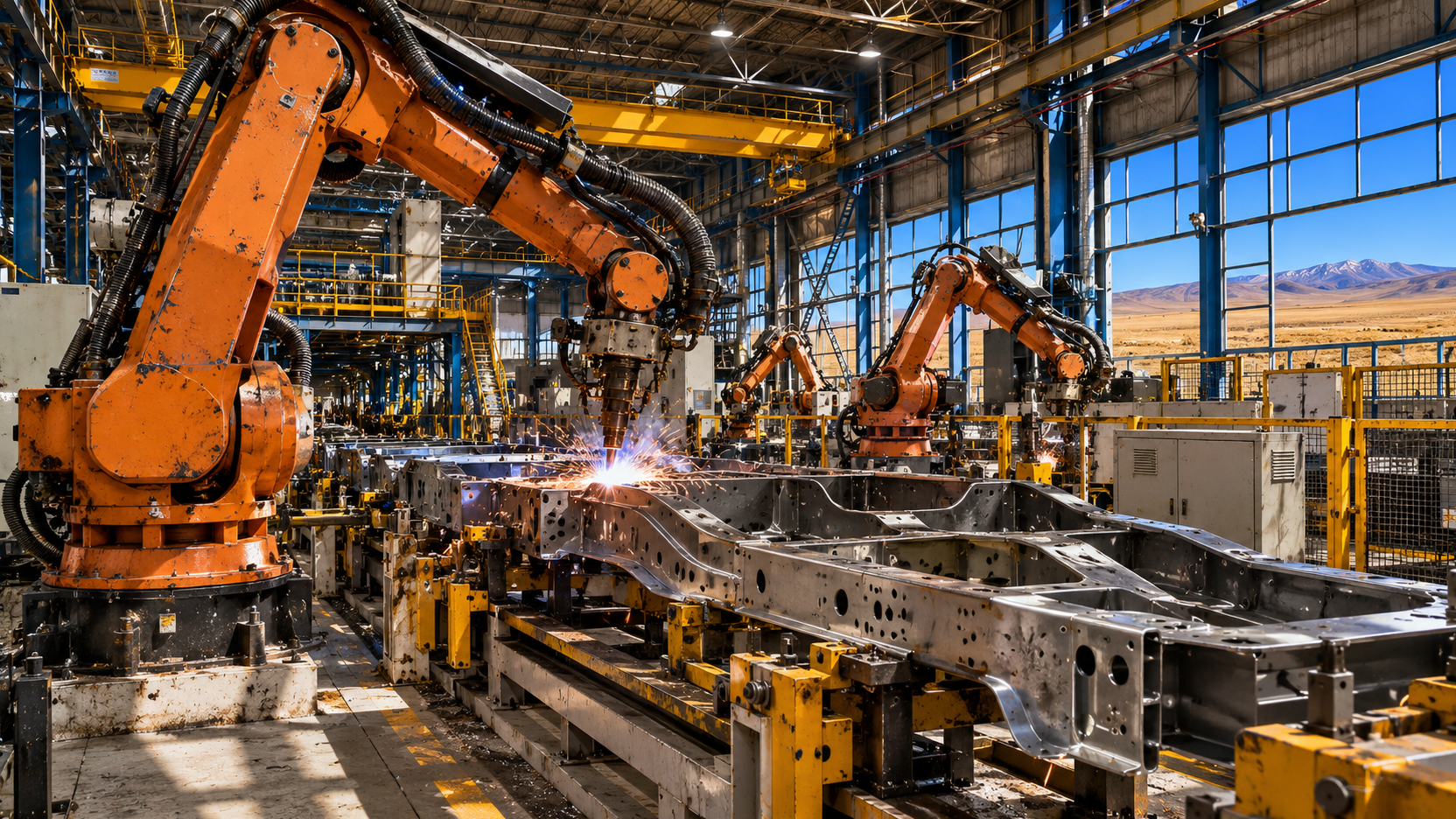
Speaking at a government press conference, Kazakhstan's Minister of Industry and Construction Yersaiyn Nagaspayev announced that, pursuant to the Head of State’s Address, around 600 new investment projects will be executed in the manufacturing sector by 2030. Following the commissioning of 190 projects in 2025, the target for 2026 is 200 projects, with 116 already operational.
Which priority industrial mega-projects are on the implementation list?
The priority projects highlighted at the briefing include two new copper smelters in Karaganda and Abai regions, the Yertys hydrometallurgical plant in Pavlodar region, the EuroChem-Karatau fertilizer complex in Zhambyl region, a potassium salt complex in West Kazakhstan region, and an ammonia and urea project in Mangystau region. The minister pointed out that these landmark projects will drive substantial capital investment, deploy advanced technologies, and create new jobs.
What localized supply chain cluster has formed around the automotive industry?
Anchored by the KIA Kazakhstan plant in Kostanay region and a multi-brand assembly plant in Almaty, a domestic small and medium-sized enterprise auto-parts cluster has emerged. Local manufacturers supply vehicle assembly plants with auto components, multimedia equipment, car seats, and automotive wiring harnesses, generating valuable industrial synergies.
How does the new capacity balance assessment rule work, and how is it tied to state support?
Addressing conditions in key sectors — such as metallurgy leader Qarmet, which accounts for around 80% of national steel output — Kazakhstan amended its Entrepreneurial Code and the Law "On Industrial Policy" to formalize a capacity balance assessment framework aimed at curbing overcapacity and supply-demand imbalances. The Ministry of Industry and Construction developed and approved a specialized methodology that evaluates the necessity of new ventures against existing operating capacities, domestic demand, and export potential. The evaluation results will be taken into account, including when state support is provided, for relevant industrial projects in Kazakhstan.
FAQ
How many manufacturing projects are scheduled for commissioning in 2026?
The plan for 2026 targets 200 manufacturing projects, of which 116 have already been commissioned at the time of publication.
What components can the domestic automotive supplier cluster currently produce?
Local enterprises primarily manufacture auto parts, multimedia systems, vehicle seats, and automotive wiring harnesses.
Rules related to this news
- How many years back can the Kazakh tax authority assess taxes?The general limitation period is three years; five years applies to large businesses, subsoil users under contract, re…Text and legal basis →
- Investment policy concept Kazakhstan 2030 targetsA Government Resolution of 31 December 2025 approved the Investment Policy Concept to 2030 (resolution number not foun…Text and legal basis →
- China Kazakhstan joint projects numberThe two countries are implementing 260 large joint projects worth over USD 62 bn; the project pipeline holds 329 proje…Text and legal basis →
Why is the new capacity balance assessment mechanism being introduced?
The mechanism aims to evaluate the viability of new projects objectively based on domestic market demand, export potential, and existing industrial capacity, thereby preventing industrial overcapacity and market imbalances.
What is the direct impact of the capacity balance assessment on businesses?
Assessment outcomes will be taken into account, among other factors, when state support is provided — not as a universal prerequisite for all industrial support measures.
Does this news involve Chinese enterprises?
The release issued by Kazakhstan's Ministry of Industry and Construction does not explicitly mention Chinese enterprises, and no inferences are made in this report.
Related reading
- More industry and policy updates: Kazakhstan investment and project news
- Setting up a project company in Kazakhstan: Company registration in Kazakhstan
Sources
- Ministry of Industry and Construction of the Republic of Kazakhstan (gov.kz), 4 November 2026: https://www.gov.kz/memleket/entities/mps/press/news/details/1323788?lang=ru