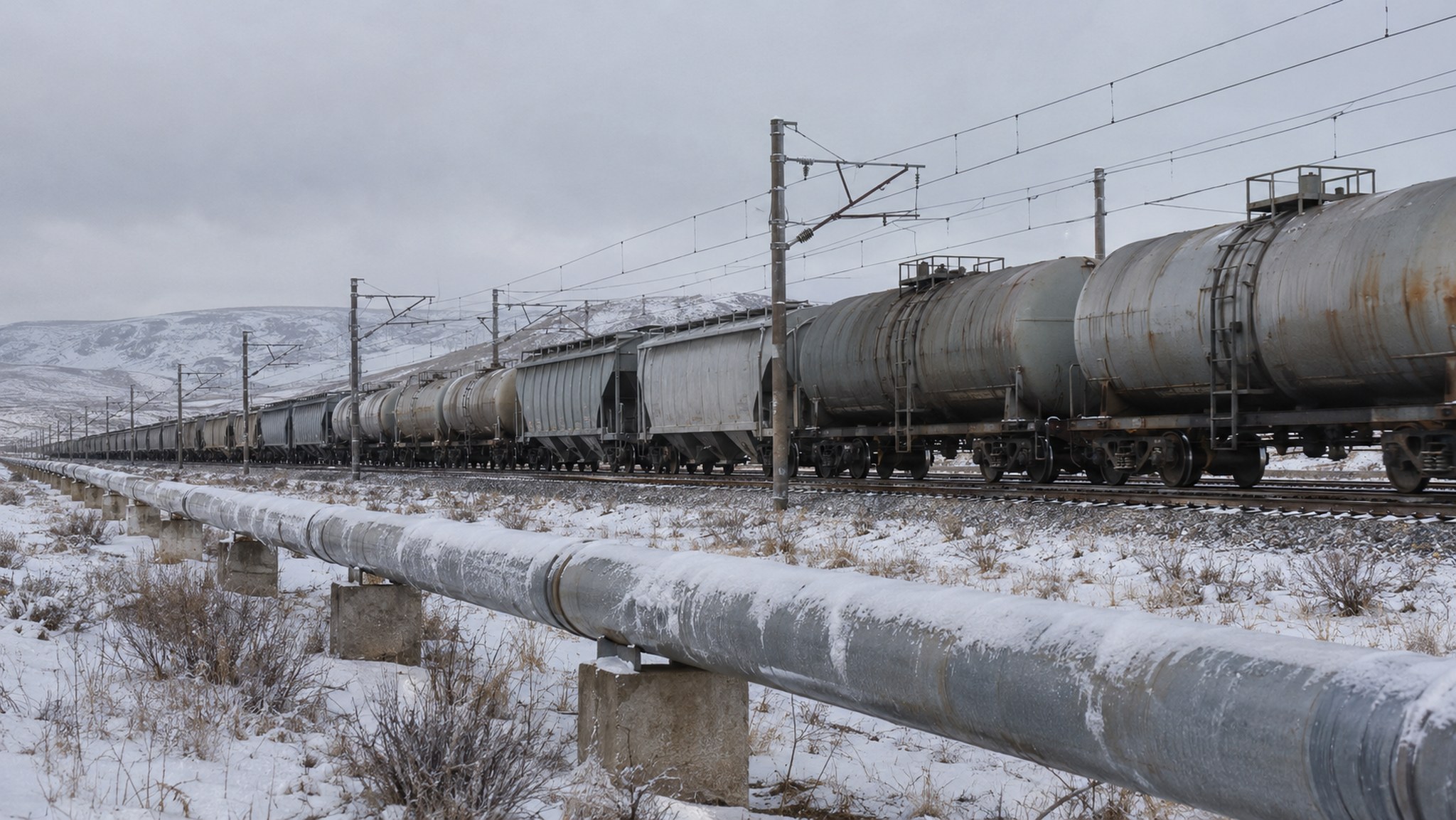
Data as of November 15, 2026 (Asia/Almaty); source dates for individual items are specified in the text
Kazakhstan Resources and Energy News Digest
Recently, Kazakhstan has witnessed a series of significant developments across strategic mineral reserves, mining regulatory frameworks, as well as cross-border energy and transport logistics. Focusing on domestic medium- and long-term nuclear power development demands, the Kazakh side plans to establish a national strategic uranium reserve system and mothball selected deposits for conservation; a new round of public consultation has also been initiated on draft revisions to regulations governing the state accounting of mineral reserves and unified cadastre registration; concurrently, cross-border freight throughput along the Kazakhstan-China crude oil pipeline and railway links sustained steady growth over the first ten months, offering solid macroeconomic data and policy references for Chinese enterprises tracking China-Kazakhstan trade and economic cooperation in energy and mining sectors.
Kazakhstan Plans to Establish Strategic National Uranium Reserve and Mothball Selected Deposits
According to reports on November 13 by independent Kazakh media outlets 24.kz and Tengrinews, Almassadam Satkaliyev, Chairman of the Atomic Energy Agency of the Republic of Kazakhstan (председатель Агентства по атомной энергии), stated at a forum that Kazakhstan plans to build a multi-tiered national strategic reserve system to satisfy domestic requirements, while suspending operations and mothballing certain uranium deposits to preserve them for future generations Tengrinews, 24.kz. Furthermore, Kazakhstan plans to place a portion of finished uranium products into storage and establish reserves of nuclear fuel assemblies necessary for the subsequent operation of each nuclear power plant. Satkaliyev noted that Kazakhstan could draw on the operational experience of the IAEA Low Enriched Uranium Bank running in Kazakhstan under the International Atomic Energy Agency framework to establish its own reserves.
Key takeaways for Chinese enterprises: Uranium mining investments and upstream resource allocation must take note of the reserve setup mechanisms, deposit development suspension schedules, and domestic consumption priorities.
Ministry of Industry and Construction Releases Draft Amendments to Rules on State Registration of Mineral Reserves
According to an announcement released on November 12 by the Ministry of Industry and Construction of the Republic of Kazakhstan, the official website stated that a draft ministerial order has been published on the "Open Legal Acts" (Открытые НПА) portal. The draft's full Russian title is «О внесении изменений в приказ исполняющего обязанности Министра по инвестициям и развитию Республики Казахстан от 25 мая 2018 года № 393 «Об утверждении Правил ведения единого кадастра государственного фонда недр и Правил предоставления информации по государственному учету запасов полезных ископаемых государственным органам»» (Draft ministerial order on amending Order No. 393 of the Acting Minister for Investment and Development of the Republic of Kazakhstan dated May 25, 2018, "On Approving the Rules for Maintaining the Unified Cadastre of the State Subsoil Fund and the Rules for Providing Information on the State Accounting of Mineral Reserves to State Bodies"). The draft intends to adjust procedures regarding geological study of subsoil, maintenance of the unified cadastre of the state subsoil fund, and provision of information on the state accounting of mineral reserves to government bodies Ministry of Industry and Construction of the Republic of Kazakhstan. The full text of the draft has also been made available for public review on the platform Open Legal Acts Portal.
Key takeaways for Chinese enterprises: Chinese enterprises conducting geological exploration and mineral extraction in Kazakhstan should monitor regulatory adjustments regarding reserve registration and cadastral reporting, and ensure compliant reporting of mineral reserve data under current regulations before the draft order is officially enacted.
Rules related to this news
Kazakhstan-China Crude Oil Pipeline Throughput Sees Steady Growth Over First Ten Months
According to a press release issued on November 12 by Kazakhstan’s national oil transporter KazTransOil, Kazakhstan-China Pipeline LLP (KCP) transported a cumulative 16.556 million tons of crude oil through its trunk pipeline system in the first 10 months of 2026, representing a 3% increase compared with the same period in 2025 KazTransOil. Specifically, the Atasu–Alashankou pipeline delivered 9.477 million tons of crude oil, up 3% year-on-year (an increase of 297,000 tons), including 1.095 million tons in export volume (a year-on-year increase of 28%) and 8.383 million tons in transit volume (a year-on-year increase of 1%). The Kenkiyak–Kumkol pipeline transported 7.545 million tons of oil, up 4% year-on-year (an increase of 313,000 tons), of which 466,000 tons were exported and 7.079 million tons were supplied to the domestic Kazakh market (a year-on-year increase of 2%); during the reporting period, pipeline cargo turnover reached 14.992 billion ton-kilometers, up 4% year-on-year.
Key takeaways for Chinese enterprises: The 28% year-on-year surge in export volumes and 1% increase in transit volumes via the Atasu–Alashankou section of the Kazakhstan-China crude oil pipeline will contribute to deepening bilateral crude oil trade and energy corridor cooperation.
Two-Way Kazakhstan-China Rail Freight Achieves Steady Increase Over First Ten Months
According to data released on November 13 by the Ministry of Transport of the Republic of Kazakhstan, total rail freight traffic between Kazakhstan and China from January to October 2026 reached 31.8 million tons, up 8% compared with 29.4 million tons in the same period of 2025 Ministry of Transport of the Republic of Kazakhstan. Both directions registered expansion: freight from China to Kazakhstan reached 12.1 million tons, a year-on-year increase of 9%, of which 5.0 million tons were transported via Dostyk station (up 13%) and 7.1 million tons via Altynkol station (up 6%); freight dispatched from Kazakhstan to China reached 19.7 million tons, a year-on-year increase of 8%, of which 13.1 million tons were shipped via Dostyk station (up 12%) and 6.6 million tons via Altynkol station (up 1%). The Ministry of Transport stated that the volume expansion results from the continuous strengthening of transport and logistics connections between Kazakhstan and China, noting border infrastructure modernization, expansion of checkpoint throughput capacity, and logistics procedure optimization as future focus areas.
Key takeaways for Chinese enterprises: The stable growth in bidirectional rail freight provides robust transport support for Chinese enterprises importing and exporting large-scale mining equipment and managing cross-border logistics turnover.
Source List
- Strategic Uranium Reserve: Tengrinews, 2026-11-13, https://tengrinews.kz/kazakhstan_news/kazahstan-zamorozit-chast-mestorojdeniy-urana-613048/
- Strategic Uranium Reserve: 24.kz, 2026-11-13, https://24.kz/ru/news/economyc/805883-v-kazakhstane-sozdadut-strategicheskij-rezerv-urana-dlya-budushchikh-pokolenij
- Draft Amendments to Mineral Reserves Registration Rules: Ministry of Industry and Construction of the Republic of Kazakhstan, 2026-11-12, https://www.gov.kz/memleket/entities/mps/press/press-releases/details/21037?lang=ru
- Draft Amendments to Mineral Reserves Registration Rules: Open Legal Acts Portal, 2026-11-12, https://legalacts.egov.kz/npa/view?id=15935188
- Kazakhstan-China Crude Oil Pipeline Throughput Over First Ten Months: KazTransOil, 2026-11-12, https://kaztransoil.kz/en/press_centre/news/6343-kazakhstan-china-pipeline-oil-transportation-volumes-increase-over-the-first-10-months-of-2026
- Kazakhstan-China Rail Freight Over First Ten Months: Ministry of Transport of the Republic of Kazakhstan, 2026-11-13, https://www.gov.kz/memleket/entities/transport/press/news/details/1328907?lang=ru
政策能查出处,落地找人对接,详情问 tumah.kz
Policies can be traced to their sources, implementation contacts can be arranged — ask tumah.kz for details
Key facts
- Kazakhstan plans to establish a multi-tier national strategic reserve system to meet domestic demand.
- Kazakhstan plans to suspend mining at certain uranium deposits and implement protective mothballing.
- 哈萨克斯坦工业和建设部 published the draft amendments to the rules for state mineral reserve accounting and cadastre registration.
- 中哈管道有限合伙企业 transported a cumulative 1655.6万吨 of crude oil in the first ten months of 2026, up 3% year on year.
- Rail freight between Kazakhstan and China reached 3180万吨 in the first ten months of 2026, up 8% year on year.
FAQ
How does Kazakhstan plan to establish a strategic uranium reserve?
The Kazakh side plans to establish a multi-tier national strategic reserve system to meet domestic demand and stock certain finished uranium products and nuclear fuel assemblies required for the continued operation of nuclear power plants.
How does Kazakhstan plan to handle certain uranium deposits?
The Kazakh side plans to suspend mining at certain uranium deposits and mothball them, preserving them for future generations.
What does the draft amendment to the mineral reserve registration rules cover?
The draft proposes amendments to the procedures governing geological research on subsurface resources, unified cadastre management of 国家地下资源基金, and the provision of state accounting information on mineral reserves to state agencies.
What was the China-Kazakhstan crude oil pipeline throughput in the first ten months of 2026?
中哈管道有限合伙企业 transported a cumulative 1655.6万吨 of crude oil through the trunk pipeline system, up 3% year on year.
How did the Kazakhstan-China rail freight volume change in the first ten months of 2026?
Rail freight between Kazakhstan and China reached 3180万吨, an 8% year-on-year increase; 1210万吨 was dispatched from China to Kazakhstan, and 1970万吨 from Kazakhstan to China.