Information current as of November 18, 2026 (Asia/Almaty); regulations are subject to the current text on adilet
Kazakhstan Common Minerals Extraction Q&A: Licences, Own-Use Limits and Expenditure Reporting
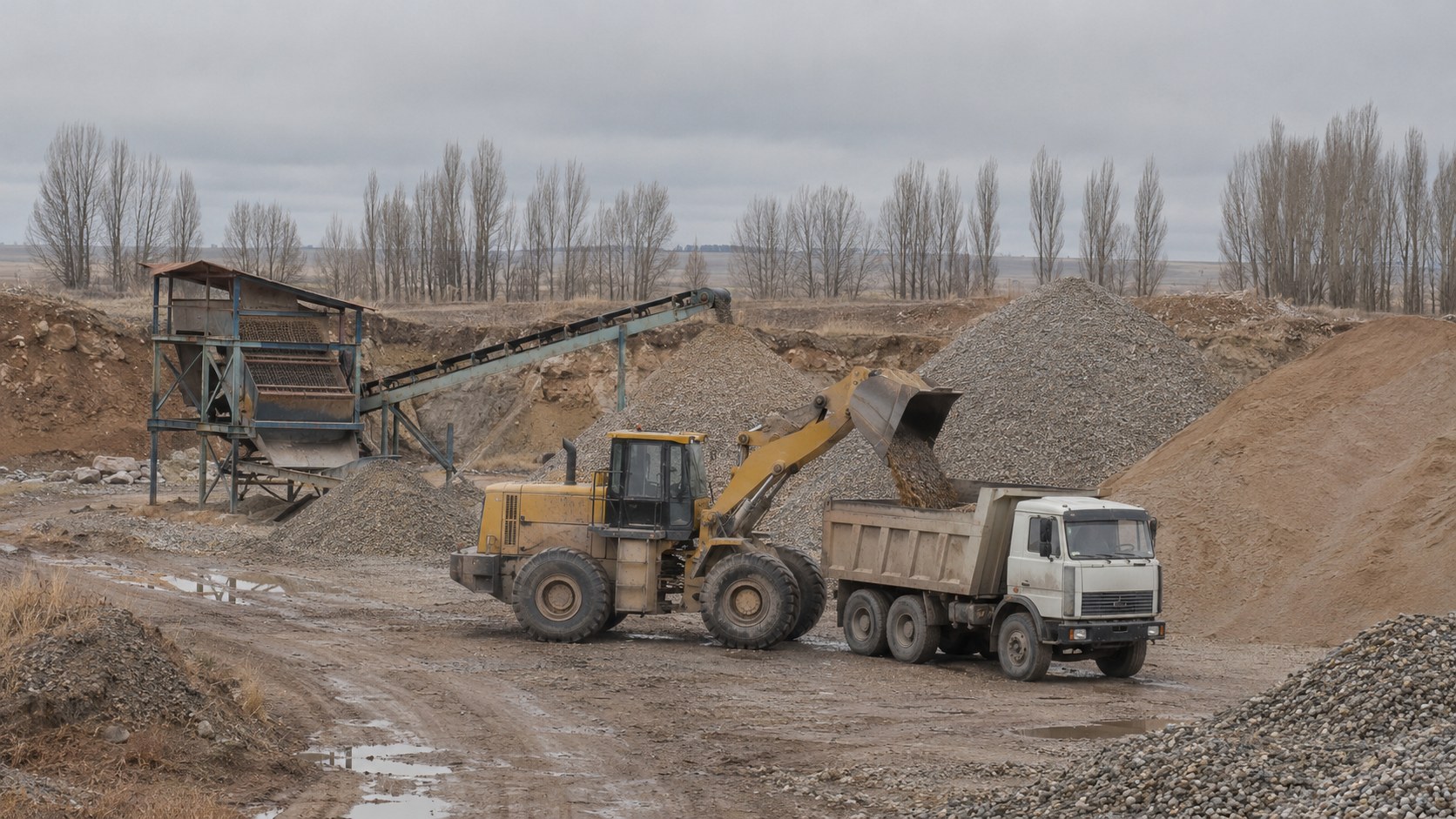
Chinese-funded enterprises engaged in highway and railway construction, housing and plant construction, or commercial concrete batching plant operations in Kazakhstan frequently need to source mineral materials such as sand, gravel, clay, and building stone locally and nearby due to project requirements. As a continuing sequel to Tumah's "Compliance Guide for Solid Mineral Extraction Licenses" (ID437) and "In-Depth Compliance Guide for Retention Status" (ID443), this article focuses on the specific legal norms concerning the extraction of "common minerals" (общераспространенные полезные ископаемые, abbreviated as OPI) under Chapter 30 of the Code of the Republic of Kazakhstan "On Subsoil and Subsoil Use," outlining key statutory obligations such as license application, the boundary between own use and commercial use, delineation of extraction plots, minimum expenditures, and periodic reporting.
Q: What specific legal provisions apply to engineering and construction enterprises extracting common minerals such as sand, gravel, and clay in Kazakhstan, and who is the regulatory authority?
Chapter 30 of the Code of the Republic of Kazakhstan "On Subsoil and Subsoil Use" specifically regulates legal relations involving the extraction of common minerals (OPI) exclusively. Pursuant to Paragraphs 1 and 2 of Article 231 of the Code, operations for the exclusive extraction of common minerals are subject to the provisions of Chapter 28 of the Code concerning the extraction of solid minerals (to the extent not in conflict with Chapter 30), and explicitly exclude the application of Subparagraph 9 of Paragraph 3 of Article 204, Article 212, Article 213, as well as the second and third paragraphs of Paragraph 3 of Article 215 of the Code Code "On Subsoil and Subsoil Use" Articles 231–237 (adilet).
In terms of regulatory authority, the extraction of common minerals is subject to territorial management: the regulation of, state supervision over, and control of compliance with license terms for operations involving the extraction of common minerals exclusively are carried out by the local executive body (akimat) of the region (oblast), city of republican significance, or the capital where the extraction plot is located Code "On Subsoil and Subsoil Use" Articles 231–237 (adilet). If an extraction plot spans two or more regional-level administrative areas, regulation and supervision are uniformly exercised by the local executive body of the administrative area that accounts for the larger proportion of the extraction plot's area Code "On Subsoil and Subsoil Use" Articles 231–237 (adilet). In case of doubts regarding specific inter-regional regulatory coordination procedures, the case-by-case response of the competent authority shall prevail.
Q: What are the differences in legal nature and application conditions between commercial extraction and non-commercial extraction (own use)?
During project construction, enterprises sourcing materials for building their own plants or constructing roads are often mistakenly treated as "own use." Pursuant to Articles 232 and 237 of the Code, the fundamental dividing line between the two lies in whether the extraction activity belongs to the land right holder's use for personal and domestic needs unrelated to entrepreneurial activities Code "On Subsoil and Subsoil Use" Articles 231–237 (adilet). Uses for project contracting, batching plant production, or building material processing all fall under the commercial scope, and a license must be obtained in accordance with the law. A comparison of their core statutory conditions is as follows:
| Comparison Dimension | Commercial Extraction (Article 232 of the Code) | Non-Commercial Extraction / Own Use (Article 237 of the Code) |
|---|---|---|
| Title Document | Dedicated common minerals extraction license | Land ownership or land use right (no independent subsoil right) |
| Right Holder | Subsoil user who has obtained an extraction license | Landowners and land users |
| Extraction Purpose | Production and business activities, commercial purposes, or engineering support | Satisfying personal, domestic, and other non-commercial daily needs |
| Extraction Methods | Professional excavation and blasting techniques permitted in compliance with regulations | Use of explosives, chemical reagents, and toxic substances is strictly prohibited |
| Transfer of Output | Sale, deep processing, or commercial transfer permitted in accordance with law | Transfer to any third party is strictly prohibited |
| Fees and Nature | Statutory taxes and fees such as signature bonuses and land rent must be paid in accordance with law | Does not constitute subsoil use operations; entirely free of charge |
| Licensing and Reporting | Must fulfill license application procedures and all periodic reporting obligations | No need to obtain any permits; exempt from all reporting obligations |
| Duration | License term does not exceed ten consecutive years | Arises and terminates simultaneously with the land right; indivisible |
*Table source: Code "On Subsoil and Subsoil Use" Articles 231–237 (adilet)*
Pursuant to Paragraphs 5 and 6 of Article 237, the right to non-commercial extraction is indivisible from the land right, and arises or terminates simultaneously with the acquisition or termination of the land right Code "On Subsoil and Subsoil Use" Articles 231–237 (adilet). As for the legal qualification of earthwork excavation and filling within a specific construction site, the case-by-case response of the competent authority shall prevail.
Q: What statutory exclusive rights does a commercial common minerals extraction license grant to the holder?
According to Paragraphs 1 and 2 of Article 232 of the Code, within territories identified by the state subsoil fund management program, the extraction of common minerals for entrepreneurial purposes requires obtaining a common minerals extraction license Code "On Subsoil and Subsoil Use" Articles 231–237 (adilet). Within the delineated subsoil plot, the holder enjoys exclusive rights for the following three operational purposes:
1. Extraction of common minerals;
2. Use of subsoil space for conducting mining operations, placing mining and (or) mineral processing production facilities, and depositing industrial mineral formations;
3. Exploration of the extraction plot, namely production exploration (эксплуатационная разведка) Code "On Subsoil and Subsoil Use" Articles 231–237 (adilet).
The second paragraph of Paragraph 2 of Article 232 of the Code provides a strict definition of "extraction of common minerals": it refers to the complex of works directly aimed at separating common minerals from their places of occurrence and extracting them, as well as works directly related thereto Code "On Subsoil and Subsoil Use" Articles 231–237 (adilet). Therefore, relying on the license, an enterprise can not only extract sand and gravel materials, but also lawfully establish supporting crushing stations, washing and screening facilities, and processing workshops within the extraction plot boundary.
Q: To which department should an application for a common minerals extraction license be submitted? What special preliminary verifications and absolute red lines against license issuance exist in the examination and approval process?
According to Paragraph 3 of Article 232 of the Code, an application for a common minerals extraction license shall be submitted to the local executive body of the region (oblast), city of republican significance, or the capital where the extraction plot is located Code "On Subsoil and Subsoil Use" Articles 231–237 (adilet). If the proposed subsoil plot spans two or more regional-level administrative areas, the applicant shall apply to the local executive body of the administrative area that accounts for the larger proportion of the requested plot area Code "On Subsoil and Subsoil Use" Articles 231–237 (adilet). The local executive body reviews the application and issues the license in accordance with the provisions of Chapter 28 of the Code.
The approval process involves strict preliminary review requirements and prohibited circumstances:
1. Preliminary Geological Verification Conclusion: To satisfy legal and regulatory requirements, the applicant must additionally attach to the application materials a specialized conclusion issued by the territorial subdivision of the competent authority for subsoil study, confirming the absence on the requested subsoil plot of solid mineral resources included in the state register that do not qualify as common minerals Code "On Subsoil and Subsoil Use" Articles 231–237 (adilet).
2. Absolute Red Line Prohibiting License Issuance: Pursuant to Paragraph 4 of Article 232 of the Code, except for the cases provided for in Paragraph 2 of Article 203 of the Code, the issuance of a common minerals extraction license for a requested territory is explicitly prohibited by law if there exist solid mineral resources other than common minerals, or prospects for their mineralization, within said territory Code "On Subsoil and Subsoil Use" Articles 231–237 (adilet).
Rules related to this news
Q: What mandatory contents must be specified in a common minerals extraction license? What is the maximum validity period?
Pursuant to Paragraph 1 of Article 233 of the Code, in addition to containing the basic information and terms specified in Article 31 of the Code, a common minerals extraction license must mandatorily specify the following three subsoil use conditions:
1. The obligation to pay the signature bonus and land use fee (rent) in the amounts and under the procedures established by the tax legislation of the Republic of Kazakhstan;
2. The annual minimum expenditure amount for operations involving the extraction of common minerals;
3. Statutory grounds for revocation of the license due to violation of license terms Code "On Subsoil and Subsoil Use" Articles 231–237 (adilet).
Regarding the license term, Paragraph 2 of Article 233 of the Code clearly provides that the term of a common minerals extraction license shall not exceed ten consecutive years (не более десяти последовательных лет) Code "On Subsoil and Subsoil Use" Articles 231–237 (adilet). When estimating mine service lifespans and investment depreciation schedules, enterprises should strictly base their arrangements on the statutory upper limit of ten years.
Q: How are the spatial boundaries and extraction depth of a common minerals extraction plot delineated? What are the statutory spatial boundary limitations?
Article 234 of the Code establishes clear statutory technical boundaries for the planar and vertical spatial delineation of common minerals extraction plots:
1. Surface Planar Boundary: Paragraph 1 of Article 234 of the Code provides that the boundaries of a common minerals extraction plot are determined based on exploration results Code "On Subsoil and Subsoil Use" Articles 231–237 (adilet). This means that plot delineation must rely on preliminary geological exploration findings and ore body occurrence boundaries.
2. Vertical Depth Lower Limit: Paragraph 2 of Article 234 of the Code explicitly stipulates that the lower boundary of a common minerals extraction plot is located at a depth of not less than thirty meters from the lowest point of the earth's surface of that subsoil plot (на глубине не ниже тридцати метров от самой нижней точки земной поверхности участка недр) Code "On Subsoil and Subsoil Use" Articles 231–237 (adilet).
The thirty-meter depth limit serves as the statutory depth control line for extracting common minerals, intended to demarcate shallow open-pit or shallow mining operational scopes. In mountainous quarries with undulating terrain, elevation calculations and the specific verification of lower boundaries must be subject to the case-by-case response of the competent authority.
Q: How is the annual minimum expenditure obligation under a common minerals extraction license calculated? Which engineering expenses can be included?
Article 235 of the Code establishes mandatory annual minimum expenditure indicators for common minerals extraction. Pursuant to Paragraph 2 of that Article, the annual minimum expenditure amount under each independent license is calculated progressively based on the extraction area:
1. Where the extraction area does not exceed five hectares (inclusive), the annual minimum expenditure is 1,160 times the monthly calculated index (MRP);
2. Where the extraction area is between five hectares and eight hectares (inclusive of eight hectares), the annual minimum expenditure is 2,300 times the monthly calculated index (MRP);
3. Where the extraction area exceeds eight hectares, in addition to the aforementioned base amount, an extra 120 times the monthly calculated index (MRP) is added for each additional hectare exceeding eight hectares Code "On Subsoil and Subsoil Use" Articles 231–237 (adilet).
Regarding project works that can offset the minimum expenditure, Paragraph 3 of Article 235 of the Code restricts them to the following four categories of actual expenses incurred by the holder during extraction operations:
1. Stripping, drilling and blasting, and other works for the extraction of common minerals;
2. Moving and transporting extracted common minerals, rocks, rock-and-mineral masses, and overburden within the boundaries of the extraction plot;
3. Dumping and (or) stockpiling of extracted common minerals;
4. Mine construction and all works for establishing infrastructure within the extraction plot Code "On Subsoil and Subsoil Use" Articles 231–237 (adilet).
Q: What periodic reports must licensed enterprises submit? Which administrative authorities are responsible for accepting them?
Pursuant to Paragraph 1 of Article 236 of the Code, during extraction operations, holders of common minerals extraction licenses must prepare and submit the following three statutory periodic reports on time:
1. Report on fulfillment of license obligations;
2. Geological report (submitted where exploration operations are conducted within the extraction plot);
3. Report on extracted common minerals Code "On Subsoil and Subsoil Use" Articles 231–237 (adilet).
Regarding submission channels and receiving authorities, Paragraph 2 of Article 236 of the Code establishes a strict dual-track division of responsibilities:
- License fulfillment report: Submitted to the local executive body (akimat) of the region (oblast), city of republican significance, or the capital where the extraction plot is located, following the procedures established by the competent authority in the field of solid minerals Code "On Subsoil and Subsoil Use" Articles 231–237 (adilet);
- Geological report and extracted minerals report: Submitted to the corresponding territorial subdivision of the competent authority for subsoil study, following the specific procedures established by the competent authority for subsoil study Code "On Subsoil and Subsoil Use" Articles 231–237 (adilet).
Regarding the specific reporting window periods and standard form completion specifications for each type of periodic report, the case-by-case response of the competent authority shall prevail.
List of Sources
- Code "On Subsoil and Subsoil Use" Articles 231–237 (adilet)
- Compliance Guide for Solid Mineral Extraction Licenses
- In-Depth Compliance Guide for Retention Status
政策能查出处,落地找人对接,详情问 tumah.kz
Policies can be traced to their sources, implementation contacts can be arranged — ask tumah.kz for details
Key facts
- Chapter 30 of the Code on Subsoil and Subsoil Use specifically regulates common mineral extraction.
- Construction contracting, concrete batching plant operations and construction materials processing are all classified as commercial common mineral extraction in Kazakhstan.
- A licence for commercial extraction of common minerals in Kazakhstan must be obtained from the local executive body at the location of the mining area.
- The term of a common mineral extraction licence may not exceed ten consecutive years, and the lower boundary of the mining area must be at least thirty metres below the surface.
- The annual minimum expenditure for common minerals is tiered according to the area of the mining area and calculated using the monthly calculation index.
- A holder of a common mineral extraction licence must submit a compliance report to the local executive body and reports on extracted minerals and exploration geology to the local branch of the competent authority for subsoil research.
FAQ
How are commercial extraction and extraction for own construction needs distinguished in Kazakhstan?
Construction contracting, concrete batching plant operations and construction materials processing all fall within the scope of commercial operations and require a licence under law. Non-commercial extraction is limited to extraction by the land rights holder for personal and domestic needs unrelated to commercial activities, and the output may not be transferred to third parties.
To which authority must an application for a common mineral extraction licence be submitted?
The licence application must be submitted to the local executive body of the oblast, city of republican significance or capital in which the mining block is located. If the block spans two or more oblast-level administrative territories, the application must be submitted to the local executive body with jurisdiction over the largest share of the block’s area.
What restrictions apply to the term of a common mineral extraction licence and the depth of the mining area?
The term of a common mineral extraction licence may not exceed ten consecutive years. The lower boundary of the mining area must be at a depth of no less than thirty metres from the lowest point of the block’s surface.
How is the annual minimum expenditure for common minerals calculated, and which expenditures may be included?
The annual minimum expenditure is tiered according to the area of the mining area: 1160 times the monthly calculation index for an area of five hectares or less, 2300 times for an area of five to eight hectares, and an additional 120 times for each additional hectare exceeding eight hectares. Eligible expenditures include actual expenditure on stripping, drilling and blasting, haulage, waste-rock disposal and stockpiling, mine construction and other related activities.
Which reports must the holder of a common mineral extraction licence submit, and to which authorities?
The licence holder must submit a report on the fulfilment of licence obligations, the geological report submitted when exploration is conducted in the mining area, and a report on the minerals extracted. The compliance report must be submitted to the local executive body, while the geological report and report on minerals extracted must be submitted to the relevant local branch of the competent authority for subsoil research.