Information as of November 15, 2026 (Asia/Almaty), regulations are subject to the current text on adilet
Practical Guide to Minimum Expenditures and Compliance Management for Solid Mineral Exploration Licenses in Kazakhstan
Enterprises holding a solid mineral exploration license (лицензия на разведку ТПИ) in Kazakhstan bear statutory exploration obligations annually, the core indicator of which is the annual minimum exploration expenditure. This expenditure does not adopt a fixed amount, but is benchmarked against the Monthly Calculation Index (МРП / MRP) stipulated by the Budget Law of the Republic of Kazakhstan, progressively tiered according to the annual stage of exploration and the number of blocks covered by the license.
Q: How are the annual minimum exploration expenditure standards stipulated for holding a solid mineral exploration license?
A: According to Kazakhstan's legislation on subsoil and subsoil use, the subsoil user bears the statutory obligation to comply with the annual minimum exploration expenditures. The calculation benchmark is the Monthly Calculation Index (МРП / MRP) established by the budget law for the corresponding fiscal year and effective on January 1 of the reporting year, and only expenditures actually incurred on the exploration block are taken into account. In cases where the license covers incomplete blocks, calculations are made according to the standards corresponding to complete blocks; if the final year of exploration is less than a full year or if blocks are relinquished during the year, the calculation is prorated based on the actual number of full exploration months in that calendar year Code "On Subsoil and Subsoil Use" Articles 191–200 (adilet). The specific statutory annual expenditure multiples are shown in the table below:
| Exploration Year Stage | 1 Block | 2 to 5 Blocks | 6 to 10 Blocks | Portion Exceeding 10 Blocks (Added for Each Additional Block) |
|---|---|---|---|---|
| Years 1 to 3 (annually) | 1,200 times MRP | 1,800 times MRP | 2,300 times MRP | 120 times MRP |
| Years 4 to 6 (annually) | 1,200 times MRP | 2,300 times MRP | 3,500 times MRP | 180 times MRP |
| Years 7 to 8 (annually) | 1,800 times MRP | 3,500 times MRP | 5,800 times MRP | 230 times MRP |
| Years 9 to 10 (annually) | 2,300 times MRP | 5,800 times MRP | 8,000 times MRP | 350 times MRP |
| From Year 11 onwards (annually) | 3,500 times MRP | 8,000 times MRP | 11,500 times MRP | 460 times MRP |
Source: Code "On Subsoil and Subsoil Use" Articles 191–200 (adilet).
Q: Which specific operational costs can be fully credited toward annual exploration expenditures?
A: The legislation explicitly lists 17 categories of field and technical activities that may be credited toward exploration expenditures under an individual license:
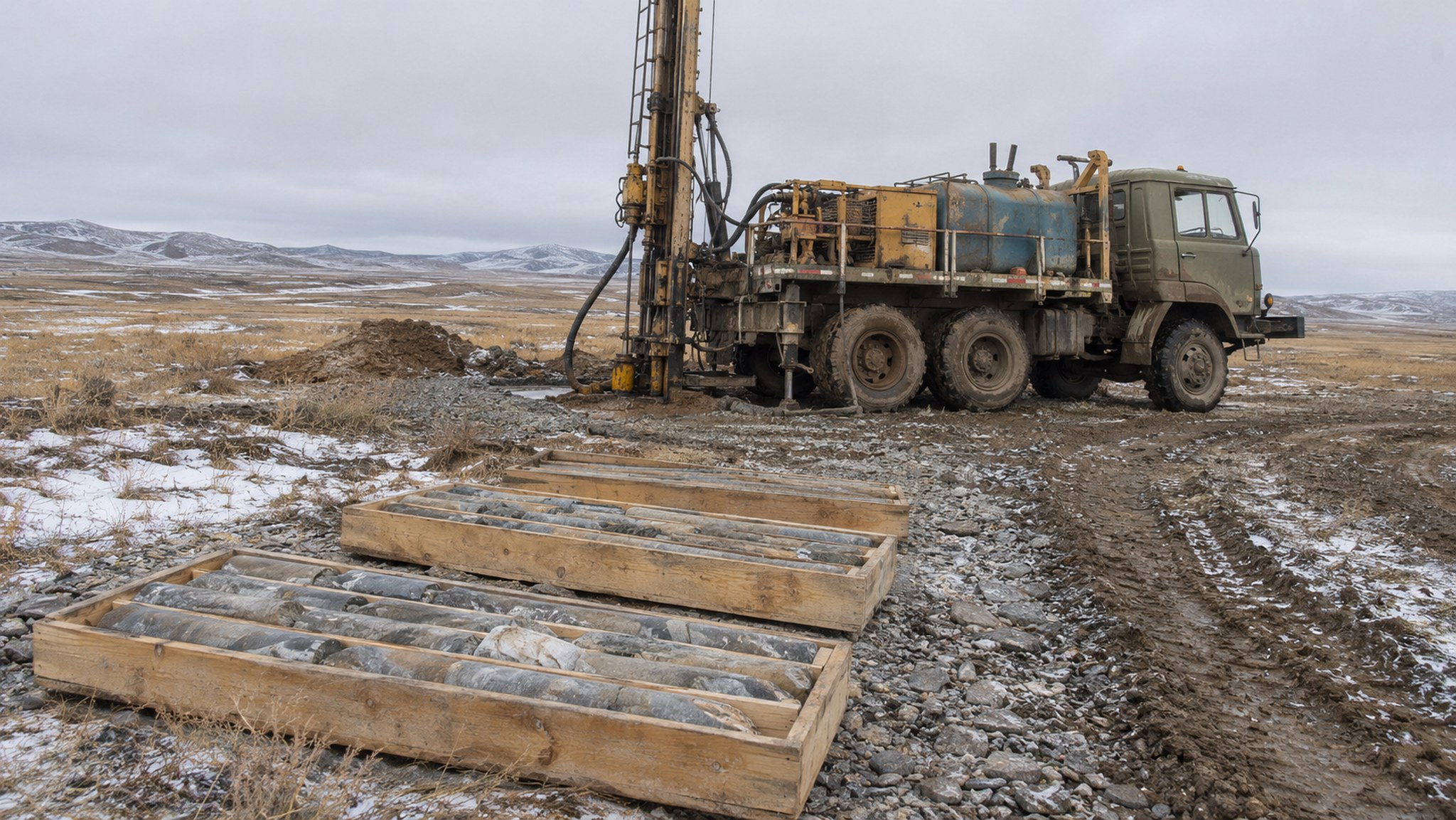
1. Geological survey operations: geological mapping, sampling, drilling, core logging, logging of non-core drilling samples, interpretation and processing of geological data, petrology, geological program planning, preparation of geological reports.
2. Geochemical operations: geochemical sampling, analysis, data processing, and interpretation.
3. Geophysical operations: ground and airborne geophysics, geophysical investigations and logging, processing and interpretation of geophysical data.
4. Remote sensing operations: aerial photography, satellite remote sensing, remote sensing imagery, image analysis, and interpretation.
5. Surveying and cartographic operations: geodetic surveying and land management, coordinate grid mapping, demarcation of coordinate lines, intersection points, and boundaries.
6. Core drilling and non-core drilling: diamond drilling, non-core drilling, as well as the construction of access roads and drill pads.
7. Excavation and equipment leasing for exploration workings such as trenches, pits, and exploratory shafts.
8. Field team supply: equipment, consumables, food rations, equipment rental, fuel and lubricants, equipment depreciation, and service fees for temporary workers.
9. Design and drafting work along with personnel remuneration, exploration-related transportation and helicopter services, field camp construction, accommodation, and catering.
10. Environmental baseline studies, feasibility studies (ТЭО) for subsequent exploration stages or mining operations, elimination of exploration consequences and land reclamation, preparation of exploration project documentation, and metallurgical/mineral processing tests Code "On Subsoil and Subsoil Use" Articles 191–200 (adilet).
Q: Is there a cap on administrative expenses? Which expenditures are explicitly prohibited from being credited toward exploration expenditures?
A: The legislation permits the inclusion of expenses related to administrative and managerial needs, accounting, scientific research, and personnel training in exploration expenditures, but imposes a strict percentage ceiling: such expenses in periodic reports must not exceed 20% of the total expenditures declared by the subsoil user Code "On Subsoil and Subsoil Use" Articles 191–200 (adilet).
At the same time, the law strictly prohibits the following 4 categories of costs from being credited toward exploration expenditures:
1. Expenditures incurred for setting boundary markers and geodetic reference marks of exploration blocks on the ground (including land surveying works);
2. Expenditures related to the acquisition of subsoil use rights (including incidental expenses incurred therefor);
3. Scientific research operations not directly related to the exploration block held under the license;
4. Compensation payments for losses paid to land owners and land users Code "On Subsoil and Subsoil Use" Articles 191–200 (adilet).
Q: Which reports must a subsoil user submit annually? What are the requirements for audits and deadlines?
Rules related to this news
- Exploration licence Kazakhstan first come first servedUnder the Subsoil Code an exploration licence is issued in order of application: 6 years, one extension of up to 5 yea…Text and legal basis →
- Subsoil Code amendments 2026 local content 70%Law No.Text and legal basis →
- How much is MRP in 2026?From 1 January 2026 the monthly calculation index (MRP) is KZT 4,325 and the minimum wage is KZT 85,000.Text and legal basis →
A: In accordance with regulations, a subsoil user must submit 4 categories of periodic reports annually:
1. Report on fulfillment of license obligations (submitted to the competent authority, verified by an auditor in accordance with the Law "On Audit Activity", or separately disclosed and confirmed in audited financial statements);
2. Report on the procurement of goods, works, and services, including local content shares (submitted to the authorized body for solid minerals);
3. Report on entities/organizational structures exercising direct or indirect control over the subsoil user (submitted to the authorized body for solid minerals);
4. Geological report (submitted to the national body for subsoil research, covering primary geological information, scientific research experiments, drilling, soil, rock, and water sampling results) Code "On Subsoil and Subsoil Use" Articles 191–200 (adilet).
Submission deadline requirements: periodic reports for the preceding calendar year must be submitted no later than April 30 of each year; if operations covered less than one calendar year, they are submitted for the actual operating period; reports for the final incomplete calendar year of subsoil use must be submitted within 2 months following expiration; upon termination of the license, the former license holder must submit a final geological exploration report within 3 months Code "On Subsoil and Subsoil Use" Articles 191–200 (adilet).
Q: How is the exploration plan (план разведки) prepared and submitted for approval? What are the key red lines for carrying out operations on the block?
A: The exploration plan is the statutory technical design document for conducting exploration operations, prepared and approved by the subsoil user itself, and must cover the types, methods, estimated volumes of work, and timelines for no less than 3 consecutive years from the date of approval or amendment; where an environmental permit or a positive conclusion of state ecological expertise is required by law, a copy must be submitted to the authorized body for solid minerals only after obtaining it Code "On Subsoil and Subsoil Use" Articles 191–200 (adilet). Conducting operations prior to filing the exploration plan with the competent authority is strictly prohibited, and carrying out unauthorized, unplanned operations is strictly prohibited.
Key operational restrictions include:
1. Prohibition against constructing capital/permanent structures (капитальные сооружения) on the exploration block, and strict prohibition against storing waste rock, tailings, and other secondary mineral resources generated from extraction and processing industries;
2. Mandatory hydrogeological studies to ascertain the physical and chemical properties of groundwater;
3. Excavation of rock and soil and soil movement up to 1,000 cubic meters is permitted solely for assay and technological sampling and must be specified in the plan; exceeding 1,000 cubic meters is permitted only in the absence of mature commercial processing technologies and subject to an expert report by a Competent Person (компетентное лицо, i.e., an individual who is a member of a recognized professional organization under the KAZRC Code or a recognized foreign professional organization), special authorization from the competent authority, and supplementary liquidation security. Unauthorized excavation in excess of limits constitutes an illegal change of the designated use of the block and directly faces license revocation Code "On Subsoil and Subsoil Use" Articles 191–200 (adilet).
Q: What cleanup and reclamation obligations must be fulfilled upon completion of exploration operations or relinquishment of blocks?
A: The elimination of exploration consequences is conducted via land reclamation, which must comply with the provisions of the Land Code; if the block is converted into a mining license, exploration cleanup obligations are merged into mining cleanup obligations Code "On Subsoil and Subsoil Use" Articles 191–200 (adilet).
For blocks not converted to extraction, the subsoil user must complete cleanup within 6 months following termination of the license; if climatic and weather conditions prevent execution, an extension of up to 6 months may be requested from the competent authority. If the ground surface or water body bed was not disturbed during exploration, cleanup operations are not required, and an inspection act of the exploration plot (акт обследования участка разведки) confirming that cleanup operations are unnecessary is signed by the persons specified in paragraph 5.
Completion of cleanup works is marked by signing the liquidation act (акт ликвидации), which is jointly signed by a commission established by the local executive body of the region, city of republican significance, or capital (composed of its representatives and representatives of authorized bodies for environmental protection, industrial safety, and subsoil research) and the subsoil user (or the entity whose subsoil use right was terminated, if existing); if cleanup takes place on land held under private ownership, permanent, or long-term paid land use rights, the landowner or land user must also sign separately. Prior to commencing exploration operations, the enterprise must provide financial security for performance based on the number of blocks and the MRP announced by the budget law; conducting operations without providing liquidation security is strictly prohibited; when voluntarily relinquishing partial blocks, the cleanup of the relinquished parts must be completed first and the corresponding security amount will be adjusted accordingly Code "On Subsoil and Subsoil Use" Articles 191–200 (adilet).
Q: If annual minimum expenditures are not met, will the license be revoked directly? What are the remediation mechanisms and revocation procedures?
A: Failing to meet the expenditure threshold does not lead to immediate license revocation; the law prescribes a remedial procedure. If the annual minimum expenditure obligation is breached, the subsoil user must make up the shortfall amount and submit a dedicated remediation report to the competent authority no later than 4 months in the year following the reporting year; the amount making up the shortfall cannot be double-counted toward normal expenditure calculations for the current year Code "On Subsoil and Subsoil Use" Articles 191–200 (adilet).
If the breach is not remedied in accordance with regulations, the competent authority will issue a written notice of violation, and the enterprise has a remediation period of 3 months from the date of receipt of the notice; if the rectification is still not completed and supporting documentation submitted in writing within 3 months, the competent authority will issue a notice of license revocation, and the license will formally terminate 3 months after the enterprise receives the revocation notice. The enterprise may file an appeal within 15 working days after receiving the revocation notice, and execution is stayed during litigation Code "On Subsoil and Subsoil Use" Articles 191–200 (adilet). Force majeure may serve as a defense, but the law explicitly stipulates: lack of funds or technical equipment, market absence of required goods and services, and administrative penalties imposed do not constitute force majeure.
Q: How is the term of an exploration license calculated? What are the statutory constraints for applying for an extension?
A: An exploration license for solid minerals is initially issued for a period of 6 consecutive years; upon expiration, a single extension application may be submitted upon request, with an extension period of up to 5 consecutive years Code "On Subsoil and Subsoil Use" Articles 191–200 (adilet).
Applying for an extension faces strict prerequisite conditions:
1. Block relinquishment threshold: If holding 10 blocks or more, applying for an extension requires relinquishing no less than 40% of the blocks, calculated based on the total number of exploration blocks included at initial licensing minus the number of blocks for which mining licenses have already been applied;
2. Uranium restrictions: If the block contains uranium mineralization or uranium deposits, the uranium-bearing blocks must be relinquished upon extension (except for associated/co-occurring minerals or the national uranium company);
3. Application timing and compliance: The extension application must be submitted to the competent authority within the 6th year of holding the license, and the competent authority reviews it within 15 working days;
4. Exclusion clauses: Where there are unrectified records of overdue land lease payments or unresolved records of default on minimum exploration expenditures prior to the application date, the extension application shall be denied by law Code "On Subsoil and Subsoil Use" Articles 191–200 (adilet).
List of Sources
- Code "On Subsoil and Subsoil Use" Articles 191–200 (adilet)
政策能查出处,落地找人对接,详情问 tumah.kz
Policies can be traced to their sources, implementation contacts can be arranged — ask tumah.kz for details