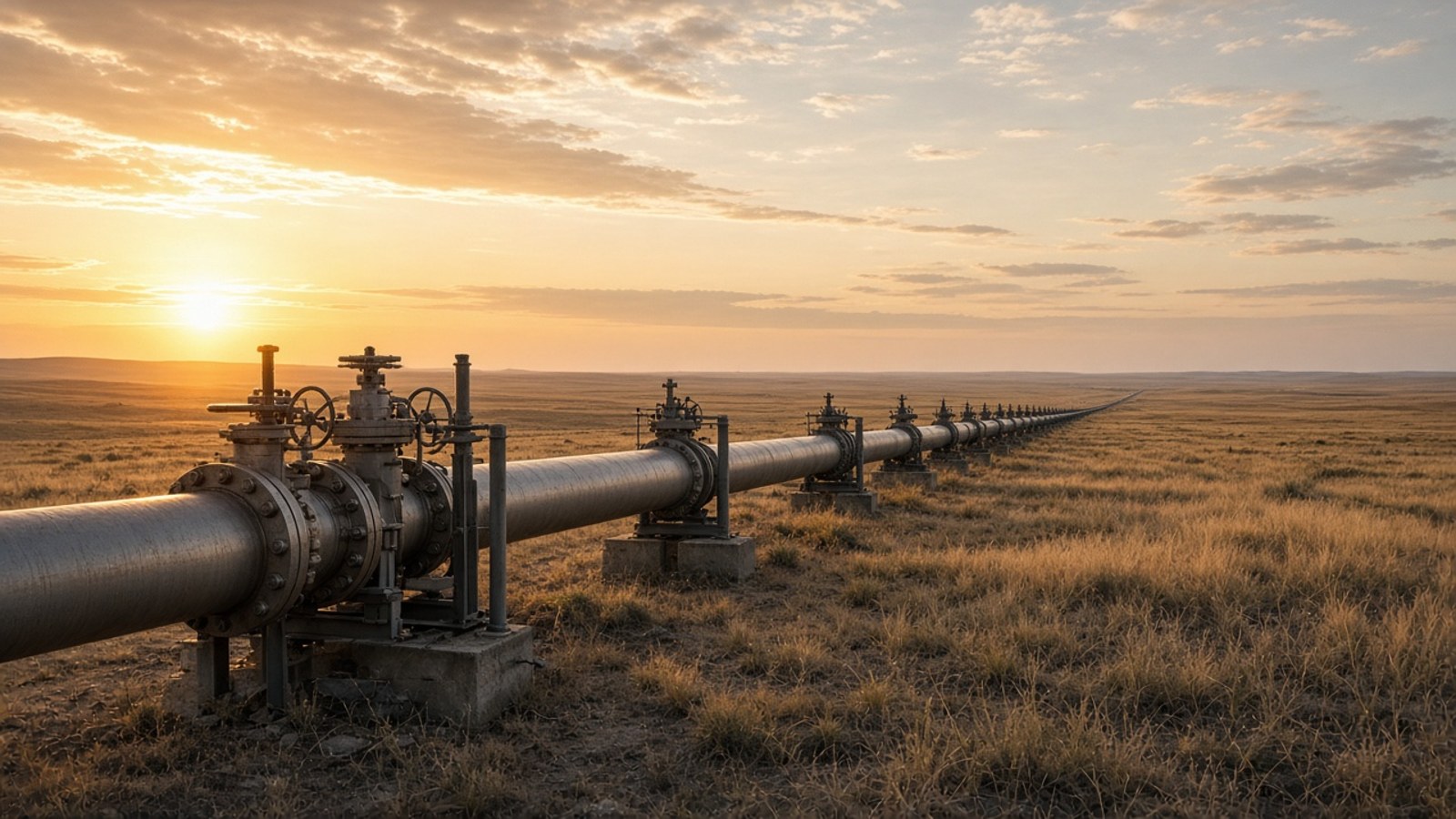
At its Issuer Day on the Kazakhstan Stock Exchange on 2 September, KazTransOil walked investors through an expansion plan. Inbusiness.kz, citing Interfax on 3 September, reports that widening two sections of the Kazakhstan–China oil pipeline system is preliminarily put at USD 327 million, or KZT 176.7 billion, to run in 2026–2030 and be financed chiefly by borrowing. The headline "Kazakhstan will invest" is too firm; what exists is a company plan shown to investors.
Start with Kenkiyak–Atyrau. Capacity today is about 6 million tonnes a year, to be raised to 15 million, roughly 2.5 times. According to KMG's 2025 annual report the section runs about 455 km through Aktobe and Atyrau regions and can operate both forwards and in reverse. Forwards it feeds oil into the Uzen–Atyrau–Samara and CPC systems, in reverse it carries West Kazakhstan oil to the Shymkent and Pavlodar refineries.
The other section, Kenkiyak–Kumkol, was designed for 10 million tonnes a year and runs about 794 km. An increase to 20 million was foreseen already at construction, and 20 million is now the target. Together with the Atasu–Alashankou section it forms the trunk line that takes oil east towards China.
To reach the new figures, five pumping stations are to be built. The project involves KazTransOil and two joint ventures. MunayTas, which owns Kenkiyak–Atyrau, is 51% KazTransOil and 49% CNPC Exploration and Development Company. Kazakhstan-China Pipeline, which owns Kenkiyak–Kumkol, is a 50/50 venture of KazTransOil and China's CNODC. So both companies running these sections have shareholders from the CNPC group.
Rules related to this news
- Can two Kazakhstan resident companies settle in US dollarsForeign-currency operations between Kazakhstan residents within Kazakhstan are prohibited except for cases listed in t…Text and legal basis →
- How do I set up a logistics company in Almaty and what permits are needed for freight transport?Usually you first register an LLP (TOO): a private-business legal entity is registered within one working day of an e-…Text and legal basis →
The idea is not new. In May 2023 KMG and CNPC agreed on a preliminary study of expanding capacity, and the Energy Ministry later set a base case on the long-term balance of oil production and distribution, 15 and 20 million tonnes. In March 2026 KMG said more than 100 million tonnes of oil had been pumped through each section since commissioning.
USD 327 million is still a preliminary cost and may change once design, feasibility study, equipment list and financing terms are fixed. For Chinese contractors and pump-station suppliers it makes more sense for now to follow the design tenders and the financing scheme than to treat this number as a contract value.
Source: inbusiness.kz (3 September 2026, citing Interfax), https://www.inbusiness.kz/ru/last/kazahstan-vlozhit-327-mln-dollarov-v-rasshirenie-nefteprovoda-v-napravlenii-kitaya
Key facts
- On September 2, KazTransOil presented the expansion plan for two sections of the Kazakhstan-China oil transportation system at the Issuer Day of the Kazakhstan Stock Exchange.
- The preliminary investment estimate for the expansion is USD 327 million, approximately KZT 176.7 billion, planned for implementation from 2026 to 2030, with borrowings proposed as the main source of financing.
- The existing capacity of the Kenkiyak–Atyrau pipeline is about 6 million tonnes per year, and it is planned to increase to 15 million tonnes.
- The initial design capacity of the Kenkiyak–Kumkol pipeline is 10 million tonnes per year, with a target of increasing it to 20 million tonnes.
- The expansion of the two pipeline sections requires the construction of 5 new oil pump stations, and both operating companies have CNPC-affiliated shareholders.
- In March 2026, KMG disclosed that cumulative oil transportation via Kenkiyak–Kumkol and Kenkiyak–Atyrau each exceeded 100 million tonnes.
FAQ
What is the investment amount for the expansion of the Kazakhstan-China oil pipeline in Kazakhstan?
The preliminary estimate is USD 327 million, approximately KZT 176.7 billion. This is only a preliminary cost and may be adjusted after the design and feasibility study are completed.
When is the project planned to be implemented?
It is planned for implementation from 2026 to 2030, with borrowings proposed as the main source of financing.
Which two pipeline sections are involved in the expansion?
It involves the Kenkiyak–Atyrau section and the Kenkiyak–Kumkol section. The capacity of the former is proposed to increase from about 6 million tonnes per year to 15 million tonnes, and that of the latter from 10 million tonnes to 20 million tonnes.
What is the shareholder structure of the operating companies of the two pipeline sections?
The owner of the Kenkiyak–Atyrau section, MunayTas, is 51% held by KazTransOil and 49% by CNPC Exploration and Development Company; the owner of the Kenkiyak–Kumkol section, Kazakhstan-China Oil Pipeline Company, is 50% held by KazTransOil and 50% by China's CNODC.
What does this mean for Chinese investors?
For Chinese engineering contractors and pump station equipment suppliers, it is advisable to follow up on subsequent design tenders and financing arrangements. USD 327 million is only a preliminary cost, not the contract amount.