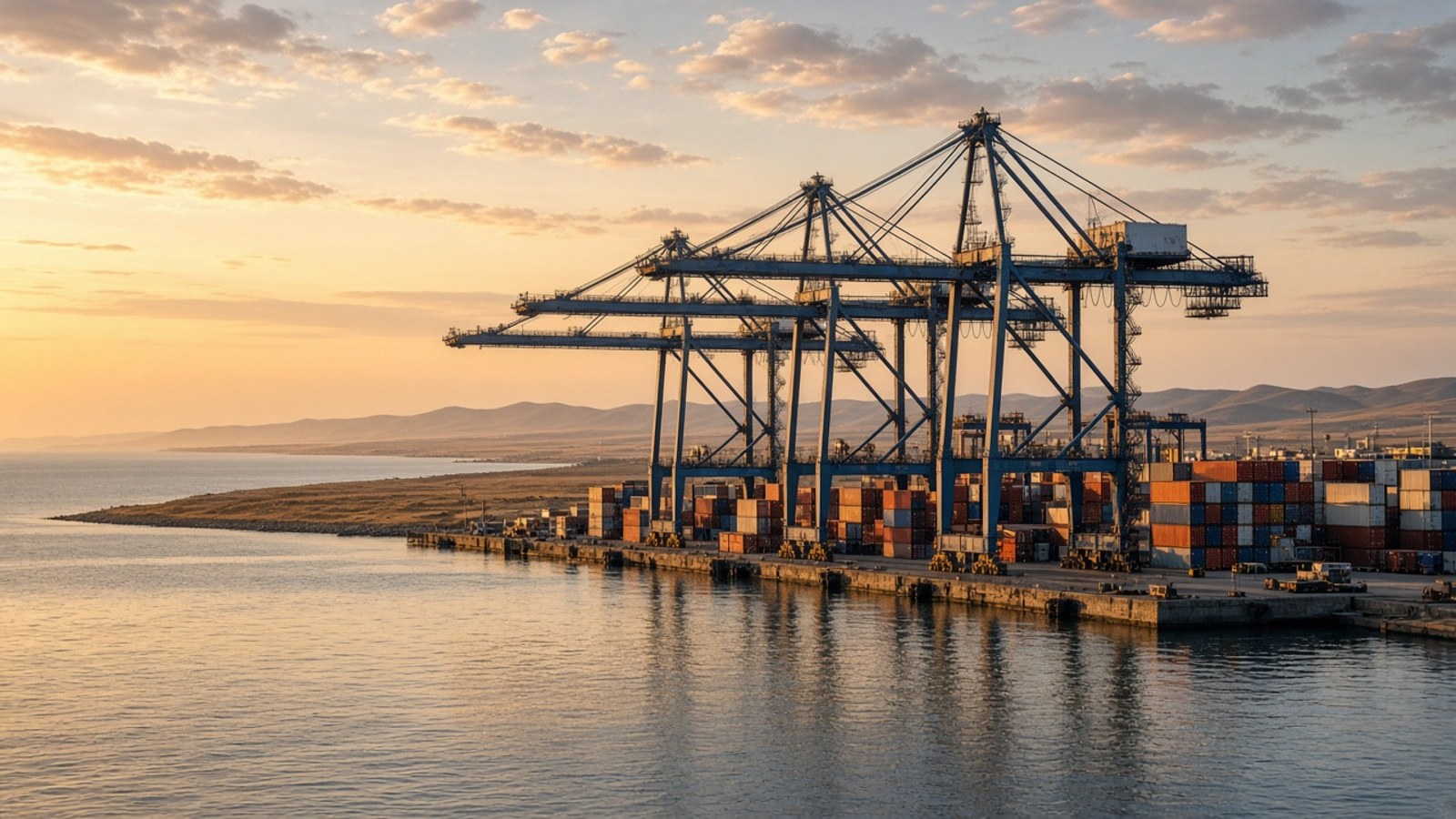
China's Guoyou Materials Group plans to build a multifunctional terminal at Kuryk Port in Kazakhstan's Mangystau Region. Public government figures put phase-one investment at about 470 billion tenge, with target annual throughput of up to 15 million tonnes and a 2026–2028 construction window.
On 16 July 2026 in Shanghai, President Kassym-Jomart Tokayev received Guoyou board chairman Yu Boyan. The presidential website records a positive response to the company's multimodal logistics-hub proposal at Kuryk and states that the port's processing capacity is to reach 15 million tonnes in the project's first year, with the aim of strengthening sea–rail integration and Middle Corridor throughput.
A week later, Prime Minister Olzhas Bektenov reviewed the same parameters during a Mangystau working visit. The Prime Minister's Office says phase one includes an automated container terminal, a rail spur linked to the national network, and supply of container ships and ferries; phase-one capacity is up to 15 million tonnes a year (2026–2028); phase two runs 2029–2031 with commissioning in 2032; after full completion, capacity is about 25 million tonnes a year with room to expand. The project is described as creating up to 800 jobs, training Kazakh technical staff, and gradually localising operations.
Timeline matters. In January 2026, KAZAKH INVEST discussed earlier estimates with Guoyou — about USD 300 million for phase one and up to USD 1.1 billion overall, plus separate figures for containers, vehicles and bulk. By July, the official line shifted to the 470-billion-tenge figure and the 15 / about-25 million-tonne targets. This article treats the July Akorda and Prime Minister releases as the primary numbers; the January note only confirms earlier engagement.
Rules related to this news
For Chinese logistics and contracting firms, the point is the transfer node. Kuryk and Aktau form Kazakhstan's eastern Caspian port cluster on the Trans-Caspian International Transport Route. Bundling terminal, rail access and fleet supply aims to tighten the China–Kazakhstan–Caucasus–Europe handoff. On 25 September 2026 at the Kazakhstan–China Investment Forum in Almaty, KAZAKH INVEST again listed “Guoyou — multifunctional port in Kuryk” among exhibition projects, so the file remains on the bilateral agenda.
Limits for readers: final financing structure, equity arrangement and an exact groundbreaking date are not yet systematically disclosed; early and later cargo-mix figures do not always map one-to-one. Follow-up should track Transport Ministry and regional decisions and investment-agreement execution, not treat planned capacity as already operating.
Sources:
Official website of the President of Kazakhstan (akorda.kz), https://akorda.kz/en/kassym-jomart-tokayev-receives-guoyou-materials-industry-group-chairman-yu-boyan-2063648
Official website of the Prime Minister of Kazakhstan (primeminister.kz), https://primeminister.kz/en/news/olzhas-bektenov-checks-implementation-of-the-presidents-instructions-on-development-of-logistics-potential-in-mangystau-region-31685
KAZAKH INVEST (invest.gov.kz), https://invest.gov.kz/media-center/press-releases/kazakh-invest-discussed-the-implementation-of-an-infrastructure-project-at-kuryk-port-with-guoyou-ma/
KAZAKH INVEST (forum release), https://invest.gov.kz/ru/media-center/press-releases/v-almaty-s-uchastiem-glavy-gosudarstva-prokhodit-investitsionnyy-forum-kazakhstan-kitay/
Key facts
- Guoyou plans to build a multifunctional terminal at Kuryk Port in Mangystau Region, Kazakhstan, with Phase I investment of about 470 billion tenge and a target annual throughput of up to 15 million tonnes.
- The construction period for Phase I of the Kuryk Port project is 2026-2028, Phase II is scheduled for 2029-2031, and overall commissioning is targeted for 2032.
- The official website of the President of Kazakhstan and the Prime Minister's Office disclosed that after the Kuryk Port project is fully completed, combined throughput will be about 25 million tonnes, with further capacity expansion possible.
- Kuryk and Aktau together form Kazakhstan's Caspian Sea eastern coast port cluster and are a key node for the Trans-Caspian Corridor's switch from land to sea transport.
- The Kuryk Port project plans to create up to 800 jobs, train Kazakh technical personnel, and gradually localize operations.
- In January 2026, KAZAKH INVEST held preliminary discussions with Guoyou on the Kuryk multifunctional port area, at which the Phase I investment scale disclosed was about USD 300 million.
FAQ
What is Guoyou's project at Kuryk Port?
Guoyou plans to build a multifunctional terminal at Kuryk Port in Mangystau Region. Phase I will build an automated container terminal, supporting railway lines connected to the national railway network, and will deploy container ships and ferries.
What are the targets and timeline for Phase I and Phase II of the project?
The construction period for Phase I is 2026-2028, with a target annual throughput of up to 15 million tonnes; Phase II is scheduled for 2029-2031, with overall commissioning targeted for 2032, and combined throughput after full completion of about 25 million tonnes.
What is the scale of the project investment?
The official website of the President of Kazakhstan and the Prime Minister's Office disclosed in July that Phase I investment is about 470 billion tenge. During preliminary discussions with KAZAKH INVEST in January 2026, Phase I was disclosed at about USD 300 million, with a full-cycle cap of about USD 1.1 billion.
What does this project mean for Chinese logistics and engineering enterprises?
Kuryk and Aktau together form Kazakhstan's Caspian Sea eastern coast port cluster and are a key node for the Trans-Caspian Corridor's switch from land to sea transport; Guoyou's plan bundles the terminal, railway access and fleet supply together, aiming to shorten sea-rail connection times from China through Kazakhstan to the Caucasus and Europe.
What uncertainties remain regarding the project?
Public materials have not yet systematically disclosed the financing structure, final equity arrangements or the exact start date; the cargo-type-specific capacity and total throughput figures disclosed at different stages are also not fully comparable. When following up, rely on subsequent approvals from the Ministry of Transport and the regional government and the implementation progress of the investment agreement.